
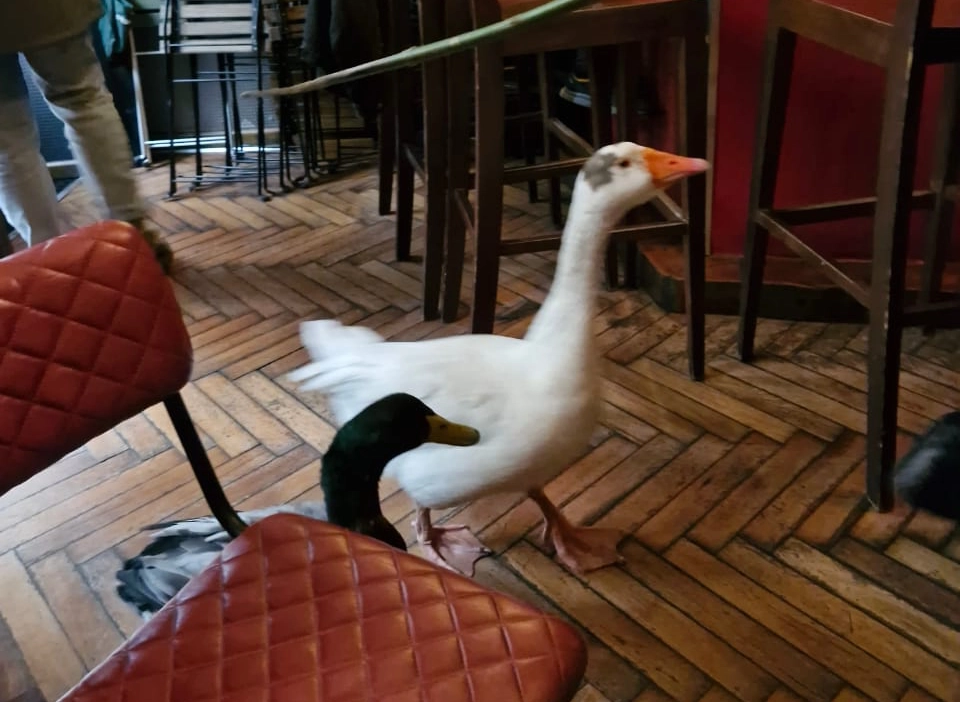
A goose and duck walked into a bar … Nah, it’s not a joke.
A goose, a duck and a man with a pointed hat really did waddle into a bar in Krakow, Poland and, after just a few days of exploring this age old, wondrous city, I thought how fitting.
You see, Krakow, is awash with ancient legends, fairytale architecture and so many other quirky bits and places.

Oh, and Krakow, celebrates dumplings, yes, everyday Polish dumplings, with a dedicated festival, and can also literally send its citizens off to the nearby salt mines (see photograph below and must-see places at the end of the blog post).

Krak-off
Krakow is also pronounced Krak-off …
While this might sound a tad rude, there’s little to decry about Krakow.
It’s historic, charming and easily explored on foot. (We managed a sobering 27 800 steps on day 1 of 5).

I mean, this popular Eastern European city even sells stuffed toy pigeons, delights in naughty dragons and enjoys hourly bugle calls from a trumpeter who never completes his tune while overlooking the largest medieval marketplace in the world.
It’s just delightful.
But before you step into this reading journey, just a reminder. As with my other “foreign land” posts (you can read about Georgia, Kazakhstan and Armenia), Poland is within five hours’ flight from Qatar and therefore qualifies as a Doha Diaries entry.
However, if I am perfectly honest, I had to take a second flight of 45 minutes from the Polish capital, Warsaw, to Krakow. But it was all worth it …
So, join me (if only to look at the photographs) as we meander down the narrow cobbled streets or dawdle over mulled wine or hot chocolate in witnessing the wonders of Krakow unfold.

P.S. Please also be reminded that I do not receive reimbursement of any form for my posts. I simply enjoy writing about my experiences, hoping that they might enlighten and entertain you, too.
The stuff of fairytales, legends and stuffed toy pigeons
Much of the charm of Krakow is found in its stories, many of them based on legend.
The Wawel Castle dragon
Like all good fairytales, there’s one about a dragon, a naughty one that started eating the good citizens of Krakow.
Legend has it that King Krakus offered his daughter’s hand in marriage to the man who could destroy the dragon.
A lowly shoemaker named Skuba stuffed a sheep with sulphur and tar to bait the dragon who lived in a cave below the Wawel castle overlooking the Vistula River. The dragon complied. Overcome with thirst, he rushed to the river where he drank and drank. Until, as legend would have it, he burst.

The trumpeter of St Mary’s Basilica
Then there’s equally ancient tale of a watchman who was sounding the alarm on his bugle as Tartars sought to invade the city way back in the 1200s. An enemy arrow struck his throat, stopping him mid-note, and ending his life. And so today, in tribute, the trumpet call, or Hejnal as it is known, is played every hour on the hour by a trumpeter who never finishes the tune.
Today, tourists strain their eyes to get a glimpse of the trumpeter at the top of St Mary’s Basilica and those that do are “blessed with good fortune”. (Phew, I managed to spot him!)

The tower brothers
The same magnificent 14th century Gothic church has two distinctive uneven towers built by two brothers who, as the story goes, competed to build the tallest tower. One brother is alleged to have killed the other to ensure his own success. But on the day of the church’s consecration, the remaining brother took his own life by jumping from the taller 82-metre tower.
Pigeons
And, then there are the pigeons. Or rather the enchanted knights in search of gold who were turned into pigeons to do some greedy prince’s dirty work! Well, that’s as the tour guides and Dr Google will have you believe.
So, while pigeons are generally discouraged from top international tourist spots, in Krakow they are openly welcomed. This means you need to be wary about where you sit.

Bar and cafe culture
And what better place to ponder these fairytale fantasies than in any of the 400-plus cafes and pubs that dot this city. Oh, and you can people-watch to your heart’s delight since Krakow is home to more than 800 000 people and is a magnet for tourists.

Yes, you are spoilt for choice, particularly in the Old Town and the Jewish quarter, Kazimierz. There’s absolutely no need to resort to pubs or cafes from franchise chains in Krakow, though they all exist.
Enjoying a hot chocolate or a glass of mulled wine in a coffee shop or an age-old pub (many of them are below ground or on different levels) is part of the culture in Krakow.
As a visitor, it is also an ideal way to recharge (feet up) and refuel (food) after charging around the many ancient tourist spots. And according to my well-travelled friend, the prices are cheaper than most other parts of Europe Certainly, Krakow is cheaper than Qatar, but more expensive than South Africa.
Food
For me, it was Poland’s pastries, dumplings and doughnuts that triumphed as fuel-food – the affordable and accessible options when you are on the go.

Bakeries groan with fresh pastries, not least with their paczki – deep-friend doughnuts filled with traditional rose-petal jam (I liked quince best), and so many other scrumptious treats.
Most restaurants offer pierogi, a dough dumpling with either savoury or sweet fillings. As mentioned, the Polish (and their immigrant communities in the US) even have pierogi festivals in August. Stews like bigos are popular too.

In the Jewish quarter, do try zapiekanka, a popular street food, that is like an open baguette sandwich. These are reasonably priced at around 15 zloty.
Market Square marks the spot
Had I had but one day in Krakow, it would have been spent in the ancient Market Square or Rynek Glowny. It is a UNESCO World Heritage site.
There is so much to see, do and learn about this fairytale setting.
The architecture, the history and culture – not just above, but also below what is the largest medieval marketplace in Europe.
If you get the opportunity, do visit the underground museum below the square. It literally takes you back in time, thanks to an archaeological dig that began in 2005.

Cathedrals, churches and a castle
Poland is a Christian country – and it shows, mainly in its ecclesial edifices. There are over 360 in the city, and many of these are in the Old Town.
You turn a corner, and there’s literally another church, many of which are open to the public. None of them are small either. They are all grand and grandiose. Apparently, this is because of its earlier status as the capital and religious heartland. Eye-catching buildings were a mark of one’s wealth, status, power and religious devotion.


And then there’s the castle.

I told you Krakow is quirky and charming.
Wawel Castle on a hill overlooking the Old Town and Vistula River has been serving as a royal residence and site for five centuries!


Souvenirs and shopping
I usually only give souvenirs cursory inclusion in such blogs, but the variety and quality of Poland’s keepsakes were particularly pleasing.

So do factor in some extra zloty for gifts and souvenirs. You can expect to find:
- All kinds of amber gifts in all colours. Both the street markets and jewellery shops sale amber, which apparently has healing properties.
- Traditional pottery. There’s nothing tacky about the pottery on sell. The traditional pottery is homemade and beautifully decorated.
- Christmas ornaments. Individually decorated Christmas ornaments made ideal gifts.
- Decorated eggs (Pisanki) for Easter.
- Vodka is particularly popular and it comes in all flavours.
- The Polish folk art is available with all sorts of merchandise, including tea towels, notepads and place mats.
While there are goodies to be purchased throughout the Old Town, I found the Jewish quarter particularly interesting. There’s a market where you buy the zapiekanka, but also umpteen arty shops with interesting goods, including vintage clothes.
We also spent one morning trawling the charity shops in suburban Krakow that are full of good second-hand clothing.

Many shops close on Sundays.
Must-see places
If your time is limited, please consider visiting these sites, many of which require pre-booking:
- The Wieliczka Salt Mines is a fascinating journey down into the bowels of the earth and back in time to discover what life was like working in a salt mine. I lost track of the number of steps down. Fortunately there is a lift to take you to the surface. Using it brings the expression “squashed like a tin of sardines” to life. Book your tour well in advance.
- A visit to concentration camp of Auschwitz is a sobering reminder of the Holocaust’s horrors. You are also advised to book well in advance.
- Oscar Schindler’s factory museum is another insight into Krakow’s difficult past during WWII. The museum in Schindler’s former enamel factory is as much about the war as it is about the man who saved hundreds of Jews.
- St Mary’s Basilica is an historic Roman Catholic parish church and one of the finest examples of Beaux Arts architecture in the country. You can see the altar for free but to climb the towers and other parts of the church, you will need tickets.
- Jewish quarter Kazimierz is where all Jewish people were forced to live in a ghetto during World War II. Walking tours of the area are available.
- Underground Museum situated below the market history, covering from about the year 1000 to the end of the Middle Ages. A guided tour brought all the artefacts to life.
Useful information
- Currency is the zloty (PLN), not the Euro. The zloty and Qatari riyal are about same, making value calculations easier.
- Visa-free stays are allowed for up to 90 days in the Schengen Area.
- It’s mainly the younger Poles who speak English. I tried to learn a few basic expressions, but nothing stuck. Polish is not easy!
- Tipping is not always expected.
- Public transport is good. Our first Uber driver was from Zimbabwe.
- It can get really cold in Poland and rains often too.
- Pedestrians are given right of way. I couldn’t believe my friend’s apparent audacity when stepping off the pavement into the road, completely confident that the motorists would stop – and they did.
- Using a card for payment is the norm.
- Most businesses open early (around 7am for supermarkets, 9am for shops and shopping malls, and midday for restaurants) and close late in the evening. Krakow certainly doesn’t sleep …


10 Responses
Thank you for sharing Debbie . We’ll definitely visit the city .
What a fascinating place. Thanks for sharing. Another one for “the list”.
Sounds fascinating Debbie !
Thanks for your description of the city, which looked to be quite old and stuffy at a glance, but now see it as rather quirky & very beautiful. And how magnificent, who would have known a chandelier can be sculpted from SALT!!
I simply love your stories from the various places you visited, so colourful and my opinion only, you should get compensation for all your blogs worth every cent, big hugs enjoy
Thank you Debbie for sharing your visit to Poland, I was absolutely blown away reading your post. Appreciate you telling me and showing me a country that unfortunately I won’t be able to visit 🥰🥰
Lovely, thank you … looks icy but beautiful!
What a fantastic time you had!
Would love to visit Poland!
You are a brilliant travel writer! Never stop!!
Love reading your posts!
Keep travelling and may all the Derrys have an awesome blessed 2026 Xx
This is beautiful. I wish to visit one day.